

Get an immediate response from AI—no form required. Would you prefer to speak with an expert? Schedule an appointment.
Debriefing is an integral part of Quality Monitoring contact centers and customer service: it’s the moment when an evaluation turns into progress. Since the first version of this article, two things have changed. Simple conversations are now routed to AI agents, while human agents handle the more difficult ones. And the AI can now prepare the debriefing on its own—provided the human agent approves it.
The Context, in Detail: When AI Takes Over the Easy Conversations: Who Helps Agents Handle Everything Else? — The Volume/Complexity Paradox, Data from Cresta, PwC, and McKinsey, and Why Monthly Coaching Is No Longer Enough.
A call summary is not a debriefing
Today, language models can summarize any conversation in just a few seconds. It’s useful, but it’s not a debriefing. The same call, viewed from both perspectives:
- Who
- Customer who has been a subscriber for 3 years; billing complaint.
- Why
- Dispute a charge of €49 and request a refund.
- Result
- Call placed; transferred to the billing department at 7:40; 12-minute call.
- Topics
- Direct debit, credit, refund period, bank account information.
Good call handling, relevant questions. The resolution isn't confirmed before closing the case, and the transfer to billing occurs before the credit has been verified in the file. This issue had already been reported on December 18.
- 1Confirm the resolution before concluding: “To summarize, the €49 credit has been applied and will appear on your next bill. Does this address your request?”
Already reported in December - 2Check the scope before transferring. Thecredit memo and the most recent debit are visible in the file: the transfer was not necessary.
- 33-Question Mini-Test:Billing Scenario, Intermediate Level—a real-life situation involving a client in a hurry.
Solo, individual, group: three formats, and how AI is changing each one
The three formats remain complementary. What will change in 2026 is the role that AI can play in them—and the role it should not play.
Agent – Supervisor, One-on-One
The meeting that follows the evaluation of an interaction. Targeted feedback: what went well, one or two priority areas, advice based on the supervisor’s experience—all in a confidential setting where the agent can ask questions. This is a key moment in the coaching process.
What AI changes: It prepares for the meeting on the supervisor’s behalf—providing detailed feedback, listing next steps tied to specific criteria, and highlighting previously noted issues. The supervisor arrives with a dossier instead of a blank page and uses the time saved to focus on the discussion itself. What it doesn’t change: The supervisor is the one who makes the decisions, adjusts the tone, and signs off.
Team or department, in a meeting
Weekly or monthly quality reviews: general trends, common mistakes, best practices observed, and campaign results. These reviews keep the team aligned with objectives, allow team members to learn from one another, and celebrate successes without singling anyone out. Their strength lies in their regularity: a one-time debriefing has limited impact, whereas an established practice contributes to continuous improvement.
How AI is making a difference: It analyzes 100% of conversations to identify recurring themes and areas for improvement at the team level, and provides audio clips for the team to listen to together. The supervisor decides what to put on the agenda; no one is singled out by an algorithm in front of their colleagues.
The officer alone, in the heat of the moment
CrossCX was a pioneer inself-assessment in customer service ( Quality Monitoring ): the agent listens to the recording, rates themselves on the evaluation grid, and identifies areas for improvement on their own—often just a few minutes after the call and without needing to hear it repeated. The job attracts people who are articulate, empathetic, and adaptable: their ability to bounce back on their own deserves to be valued, not sidestepped.
How AI is changing things: Self-debriefing is now possible without waiting for the supervisor—the agent receives structured feedback on their own evaluation, a mini-test for practice, and a record of their progress. The supervisor sees what has been done, not every single action; this is essential for ensuring that working independently remains a space of trust.
Human advisor, AI agent: same evaluation grid, two debriefings
The underlying trend is well known: simple requests are increasingly handled by AI agents—whether voice-based or via chat—while human agents handle conversations where the brand bears responsibility. The “ Quality Monitoring ” must evaluate both using the same criteria to compare like with like. However, the resulting debriefing is not intended for the same audience.
Feedback is a management decision: it takes into account the week, seniority, and the individual. That’s why nothing is finalized without the supervisor’s approval, and why the counselor always understands the basis for each point.
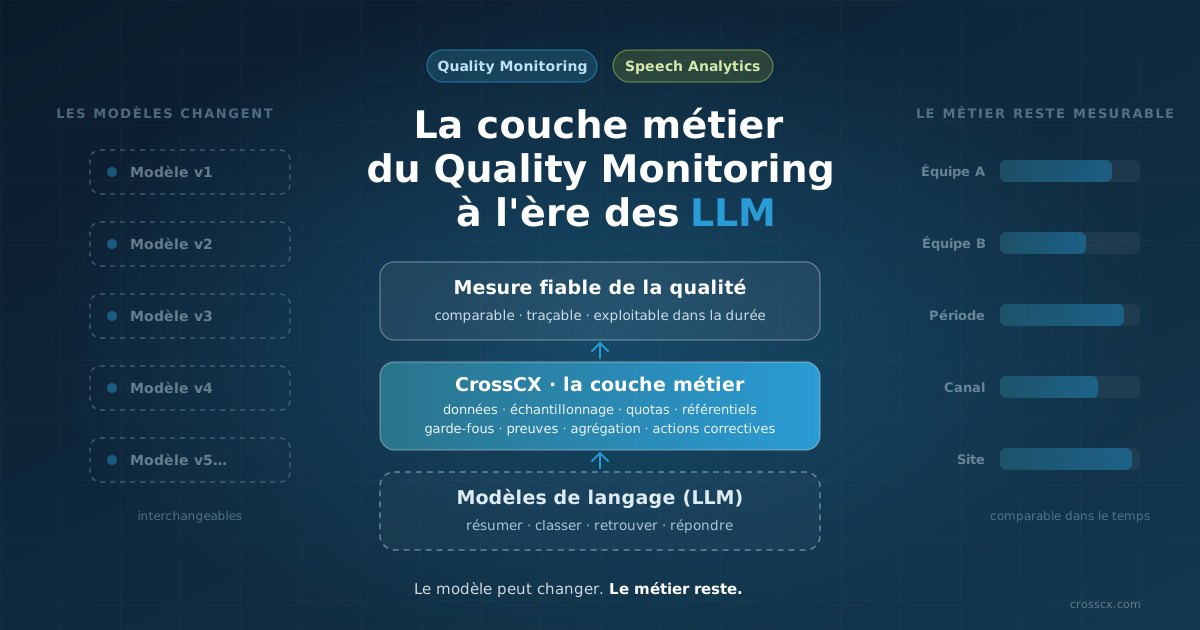
A bot requires no maintenance: the debriefing becomes a stream of feedback to those who configure it. The mechanism is described on the AI agent evaluation page. It is the same layer of Quality Monitoring that measures both, and this is what allows us to control the distribution of roles rather than simply accepting it.
The Benefits of a Debriefing, Depending on Your Role
Real-time control
Address issues right after the interaction, not three weeks later. Gallup has shown that frequent and meaningful feedback drives performance rather than hindering it.
Cohesion and Best Practices
The group debriefing brings everyone together around quality objectives: we celebrate together, we address discrepancies without stigmatizing anyone, and mistakes become learning opportunities.
Coaching and Skills
One or two priority areas per meeting, along with advice based on experience. Employees who receive daily coaching are significantly more motivated to do excellent work.
Accelerated Onboarding
Holding daily debriefs during the first few weeks shortens the learning curve and instills the company’s culture before bad habits take root.
For a supervisor, debriefing isn’t a burden—it’s a tool that helps them stay on track day after day, motivate the team, and develop each person’s potential. With AI handling the prep work, they can get more done without having to spend their evenings on it.
Action Plans That Get Off the Ground
The debriefing is the moment when the action plan is put to the test in the field: evaluation results are transformed into practical advice and actionable goals. Without it, evaluations remain nothing more than scores.
Continuous improvement
The recurring themes that come up during debriefings—such as a misunderstood process or a tool that gets in the way—are invaluable for revising a script, clarifying a procedure, or creating a training module.
Compliance and Risks
An alert regarding a disqualifying criterion triggers an immediate debriefing: we show the clip, review the rule, and ensure it is understood. Recurrence rates drop, and a record is kept for the audit.
Promoting a Customer-Centric Culture
Quality committees share verbatim comments and feedback from large-scalesatisfaction surveys: the CX vision is reaffirmed, not just measured.
And a new responsibility: establishing the rules for AI-assisted debriefing. The prompt, the generated blocks, the frequency, what the advisor sees, and what management sees. The quality manager is responsible for setting this framework.
The structured learning path at CrossCX, from assessment to progress
To ensure that the debriefing does not depend on individual goodwill, it must be built into the process. Here is the workflow as it currently exists on the platform, with the two steps added in 2026.
- Assessment, whether human or automated
Rating rubric, scores, and supervisor comments; based on a sample or 100% of conversations using automated quality monitoring. The rubric is the same for advisors, service providers, and AI agents.
- Alerts and Triggering
Score below a threshold, elimination criterion not met, prohibited word detected by the Speech Analytics system: a notification is sent to the supervisor or quality manager, and a debriefing task is created with a due date. Nothing gets overlooked, and reminders (“5 interactions not debriefed this week”) help ensure the practice is followed consistently.
- The New AI-Assisted Debriefing
Since the evaluation, a “Debriefing” button opens the pre-prepared feedback: detailed comments, next steps linked to the criteria, an LMS mini-test, and a comparison with the history. The supervisor reviews it, refines a section and regenerates it on their own, approves it or replaces the test with another corrective action, and then sends it.
Demonstration (1 min 25 sec): generation, supervisor adjustments, submission, advisor view, follow-up. What the advisor receives
A message rewritten for him, in a peer-to-peer tone, signed by his supervisor. His next steps to check off as he goes through the calls, his mini-test to take in the app (results recorded in the LMS), and his previous debriefings showing how his score has changed. He can see what each point is based on and can address it.
- Corrective Action and Microlearning
Individual coaching, peer feedback with a mentor, existing Listener LMS , listening to a sample call, and role-playing in pairs. The generated mini-test is created in the LMS and linked to the agent’s training path throughthe QM–LMS integration: we don’t just point out what needs improvement—we provide the tools to address it right away.
- Long-Term Follow-Up New
At each new evaluation, the "next steps" from previous debriefings are cross-referenced with the day's checklist and assigned a status:
CorrectedPersistsNewTo be monitoredAn item marked “done” by the employee but still rated 3/5 appears as pending: the status is based on ratings, not self-reports, and the supervisor can adjust it. This is the progress log, retained for a rolling six-month period, which is invaluable for preparing for the next review, for a management handover, and for demonstrating the progress made.
- Reporting and Evidence
The dashboards compare pre- and post-coaching results by team, campaign, or criterion; they guide the subsequent group debriefing and demonstrate to management or the client that each area of focus has led to follow-up action.
Self-Assessment: Is Your Debriefing Ready for the Age of AI?
Eight statements. Check the ones that apply to you today.
The Importance of Structuring the Process
Debriefing isn’t just another item on the contact center’s checklist: it’s the link that turns evaluations into action and sustainable progress—for perceived quality, customer loyalty, and employee retention. It acts as the glue between strategy and execution: it aligns the customer promise with the reality on the ground, ensuring that every interaction counts and is followed up on.
What has changed is what’s at stake. When the most difficult conversations are handled by humans, a sloppy or absent follow-up costs more than it used to, and AI makes it possible to provide a well-thought-out follow-up after each evaluation. There’s one condition, though: the AI must prepare, the supervisor must decide, and the advisor must understand. Remove any one of these three, and the tool does more harm than good.
AI handles the easy stuff. The advisor handles the hard stuff.
The debriefing is what helps the advisor cope with it and make progress.
See AI-assisted debriefing on your own evaluation forms
A 30-minute demo tailored to your criteria, your advisors, and your bots.
Frequently Asked Questions
How often should you hold a debriefing?
After every evaluation that warrants it—not just once a month. With AI handling the preparation of the feedback, the frequency is no longer limited by the time it takes to write it but by the agent’s ability to absorb the information: one or two points per debriefing, a pace the team is familiar with.
Does AI-assisted debriefing replace the interview?
No. He prepares it. The supervisor arrives with feedback, next steps, and the background information already compiled, and devotes the meeting to what requires a human touch: tone, context, and decision-making.
How can we prevent debriefings from turning into surveillance?
It is tied to an evaluation—approved and signed by a supervisor—at a predetermined frequency. The advisor can see what the evaluation is based on and can respond accordingly. Analyzing 100% of conversations helps identify the right moments, not to reject everything.
What about an AI agent?
The same template, but no follow-up: the debriefing becomes structured feedback sent to the bot’s developer or its knowledge base. Same process, different recipient.
Where should I start?
Based on the self-assessment above. The items you did not check are, in order, your action plan. We can work through it with you using your worksheets.