
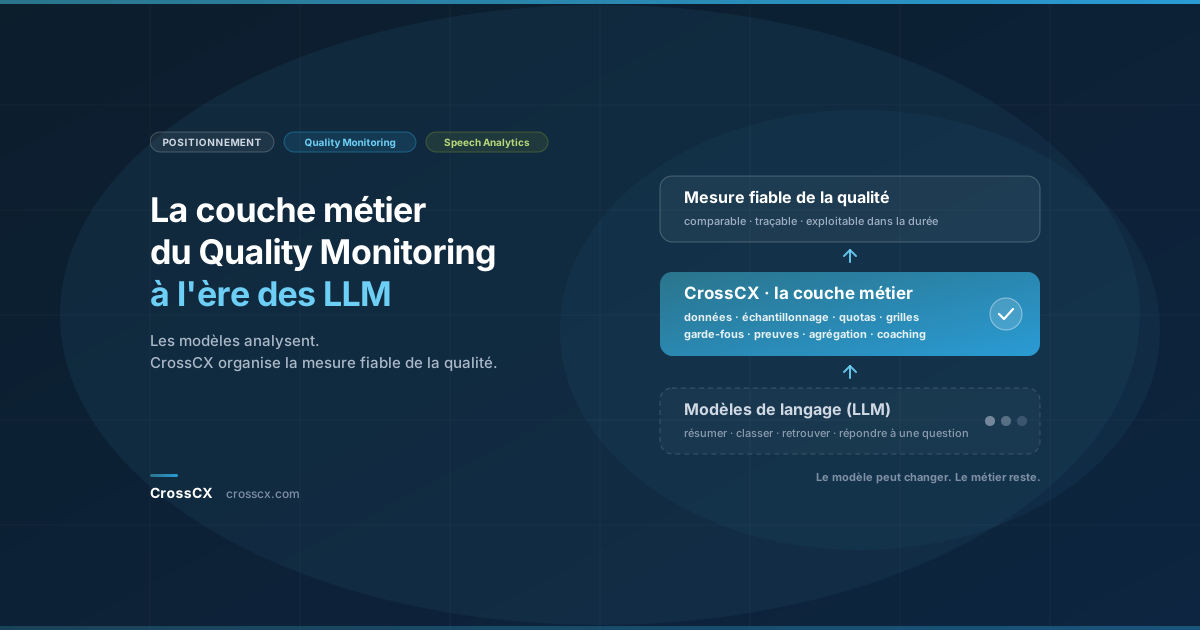
Summarizing a call, finding a topic, explaining why a customer was dissatisfied: language models can already do all of this, and they’ll do it even better in the future. So that’s not where we create value a CrossCX. It begins when a good answer is no longer enough—and a system is needed.
Each new generation of LLMs pushes the boundaries of what can be achieved with a single question. For a platform like Quality Monitoring and Speech Analytics, the temptation would be to defend, one by one, the functions that the models are taking over. We’ve chosen the opposite approach: to clearly state what we’re leaving to the models, and where we’re focusing our expertise—on the right layers, and only those.
Our Positioning Guidelines
While an LLM may be able to handle a single question correctly, that’s probably not where “ CrossCX ” should focus its value.
Our value begins when analysis must become repeatable, controlled, comparable, sampled, traceable, and usable over the long term.
1. What We’re Happy to Leave to the Models
Certain tasks have become—or will become—conveniences. We use them, choosing the models best suited to each purpose, but we don't claim to differentiate between them. In a single conversation, a model already knows:
"Summarize that call for me."
An LLM can already do this very well, in just a few seconds, without any configuration.
Identify a motif, a subject, or an intention
The classification of a single conversation is becoming increasingly commoditized.
"What happened during that call?"
A simple conversational question, to which a model responds directly.
"What is the sentiment behind this exchange?"
One-time analysis of tone, emotion, or satisfaction no longer requires a dedicated tool.
Write a summary, a rephrasing, or a response
Generating text based on a conversation is a capability of current models.
For these one-time needs, a quick query to an LLM tends to be free. We have no reason to make it more complicated than it is—or to charge for it as if it were expert advice.
2. What " CrossCX " brings to those around them
What sets us apart goes beyond the modelsthemselves: it lies in the data, sampling, quotas, reference frameworks, evaluation, evidence, governance, and aggregation. It is this foundation that enables automated,Quality Monitoring , with results that remain comparable from month to month. In practical terms, here is what we stand for.
Analyze hundreds of thousands of conversations in a consistent manner
Industrialization, common rules, and aggregation: the same logic applied to every interaction, day after day.
Import multiple sources every day
Connectors, standardization, and workflow orchestration—telephony, chat, email, CRM—to ensure that analysis is always based on clean data.
Choose which conversations should be evaluated
Business sampling: It's not the easiest conversations to find that should be evaluated, but the most useful ones.
Manage Evaluation Quotas
By team, site, time period, and status: the QM framework that organizations have spent years building—and that cannot be summed up in a single question.
Ensure that a grid is applied consistently
Calibration and safeguards, to ensure evaluations are precise rather than approximate—and consistent across all teams.
Provide evidence for each criterion
Traceability: Each note links to the excerpt that supports it, so it can be challenged, explained, or used in coaching.
Compare agents, teams, locations, time periods, and channels
A data model and stable aggregations that are independent of the model used to generate the analysis.
Detecting drift in a model or rule
Long-term monitoring: A change in a rating must be attributable to on-the-ground factors, not to a model update.
Choose among several models depending on the task
Orchestration: one model for transcription, another for evaluation, and a third for synthesis.
Turning Evaluation into Coaching and Corrective Actions
Business workflow: from the report to the debriefing, from the debriefing to the action plan, from the action plan to training.
And, at the end of the process, the reporting remains consistent despite the change in LLM. It is this distinction that we want to make extremely clear:
Models perform analysis. " CrossCX " explains how this analysis becomes a reliable measure of quality.
The LLM answers a question. CrossCX builds the system that allows you to ask the right question of the right sample, using the right rules, and then compare the answers over time.
3. Why This Is Still Necessary with Autonomous Agents
The need does not disappear with agent-based AI. It simply shifts.
Tomorrow, an AI agent will likely be able to retrieve a conversation on its own, analyze it, answer a question, suggest a note, trigger an action, or call another agent. These are basic decisions, and it will handle them well. But someone will always have to decide:
- which conversations to analyze, and based on what sampling method;
- according to what rules and based on what standards;
- with what limits and safeguards;
- what evidence is needed to ensure that every decision remains justifiable;
- how often and in which population;
- and how to then aggregate millions of basic decisions into a meaningful metric.
An autonomous agent also needs policies, limits, oversight, and evaluation. That is exactly what an organization expects from its Quality Monitoring. We are building CrossCX so that the agents of tomorrow can rely on it—rather than each having to reinvent high-quality governance on their own.
The Promise, in a World of Agents
AI can make basic decisions .CrossCX ensures the system remains consistent.
In fact, this applies both ways: when AI agents are responding to your customers, their performance must be evaluated with the same rigor as that of your customer service representatives—using the same criteria, the same evidence, and the same standards for comparison.
4. An architecture that can change its model without changing its business function
We don't want to replace the models. We want to make their results usable on an organizational scale. This has a simple architectural implication: the business logic must never depend on any particular model.
CrossCX selects and orchestrates the most appropriate building blocks for each task—transcription, detection, evaluation, synthesis—rather than making the customer dependent on a single provider. GPT today, another model tomorrow: your metrics, quotas, historical data, and comparisons remain the same. A team’s score in January remains comparable to its score in June, even if the model has changed in the meantime. That’s the role of our AI connectors: to plug in, replace, or combine models without altering the reference data.
The model may change. The quick question may become free. But the standards, rules, evidence, and history of your assessments remain yours—and remain comparable.
Business models change. The profession remains.
Models are capable of doing more and more. Our job is to organize the aspects that must remain consistent: what we measure, on which population, according to which rules, with what safeguards, and how we then transform millions of analyses into useful decisions.
This is how we see the future of Quality Monitoring and Speech Analytics : not a race against models, but the business layer that makes them usable—for your teams today, for your AI agents tomorrow.
Frequently Asked Questions
CrossCX Does it use LLMs?
Yes, and from several providers. We don’t develop our own language models; instead, we select and orchestrate the ones best suited to each task—transcription, detection, evaluation, and synthesis. Our value lies in what surrounds these models: data, sampling, quotas, grids, evidence, and reporting.
Why not just ask an LLM?
For a one-time conversation, go ahead: it’s quick and effective. To measure the quality of customer service over time, the same question must be asked of the right sample, following the same rules, with evidence for each response, and then the results must be aggregated and compared across teams, locations, and time periods. It’s a system, not a single question.
What happens when a better model comes out?
We connect it via our AI connectors, calibrate it to your metrics, and verify that it doesn’t skew your results for the wrong reasons. Your benchmarks, quotas, and historical data remain unchanged—which is precisely what makes the model transition seamless.
Can an autonomous AI agent replace a web Quality Monitoring ing tool?
It will handle some of the basic decisions—analyzing a conversation, suggesting a rating, triggering an action. But it will always need policies, limits, evidence, and an aggregated metric to ensure that its decisions remain consistent across the organization. That’s what CrossCX provides.
Let's Talk About Your " Quality Monitoring " in the Age of LLMs
Find out how CrossCX transforms model analytics into a reliable, comparable, and actionable measure of the quality of your interactions.