Get an immediate response from AI—no form required. Would you prefer to speak with an expert? Schedule an appointment.
A lower volume does not necessarily mean a lighter workload. Automation is gradually shifting human interactions toward the most complex situations.
1. The paradox: fewer calls, more weight per call
For the past two years, the narrative has been the same in nearly all contact centers: AI agents—whether voice-based or chat-based—are handling an increasing share of simple requests. These include order tracking, scheduling, password resets, address changes, and the initial assessment of complaints. The volume of calls reaching agents is decreasing—or will decrease—and this is presented as a relief.
This is partly true, and partly an optical illusion. What’s being taken away from customer service representatives are the short, predictable, scripted conversations—the ones that used to provide a breather between two difficult cases. What remains for them is everything the automated system couldn’t—or wasn’t allowed to—handle: the complaint that has already been rejected once, the billing dispute, the customer threatening to leave, the situation the script didn’t anticipate, and the vulnerable person who needs to be listened to with care. Fewer conversations, but longer and more emotionally charged ones—and the outcome of each directly impacts the brand’s image.
The burden doesn't go away. It just becomes more concentrated.
AI takes the easy route.
Who helps humans with the hard stuff?
2. What Cresta, PwC, and McKinsey Say
This shift is not an isolated observation from the field; it is evident in three sources that differ in both method and perspective.
- 50%reduction in call volume possible within five years thanks to AI, according to customer service managers surveyed by McKinsey. The “moments that really matter” remain human, and the agent becomes a “superagent.”McKinsey, The Evolution of Customer Care, 2024
- 86%of consumers consider human interaction important to their brand experience; 52% have stopped buying a brand after a bad experience.PwC, 2025 Customer Experience Survey, 5,511 consumers
- 49%of advisors say they have received effective on-the-job coaching. With personalized coaching, 91% say they are happy at work, compared to 57% with standard coaching.Cresta, State of the Agent Report, 1,000 advisors
Cresta, a provider of AI solutions for contact centers, puts it bluntly: as AI handles the day-to-day volume, the interactions that are escalated to humans become “more complex, more emotionally nuanced, and higher-stakes.” As early as 2022, McKinsey observed that calls were “more numerous and more complex than before,” and nearly one in two managers reported an increase in attrition, with burnout ranking among the top causes. PwC adds the missing piece: customers are happy to use AI to track a delivery, but much less so for what really matters, and they punish the brand—not the channel—when the experience is poor.
Taken together, these three observations paint a picture of an industry that is becoming increasingly focused on its most challenging aspects, with clients who are more demanding in these situations and advisors, fewer than half of whom feel they are receiving adequate support.
3. The profession ten or fifteen years ago, and today
Fifteen years ago, a call center’s performance was measured by average handling time, the hang-up rate, and adherence to the script. A typical day involved handling forty to eighty calls, the vast majority of which were standard inquiries; expertise was measured by speed and compliance; a difficult call was the exception, which was escalated to the supervisor. The Quality Monitoring evaluated a sample—a few calls per month per agent—and debriefings took place when the schedule allowed.
Yesterday
- High volume, mostly simple requests
- Script, DMT, Compliance
- A difficult call is the exception—it has become the norm
- Sample-based evaluation, monthly debriefing
- Expertise = speed and consistency
Today
- Declining volume, majority of cases are complex
- Judgment, discretion, knowledge of exceptions
- Tough calls are the norm—with no safety net
- 100% of conversations are analyzable; debriefing to be determined
- Expertise = problem-solving and maintaining the relationship
Today, what used to be the exception has become the norm. The sales associate is the brand’s last human face—the person to whom customers are entrusted precisely because an automated system wasn’t enough. It’s a more interesting, more skilled profession—and one that’s held in higher regard when it is. It’s also a job with no downtime and no safety net, where mistakes can no longer be lost in the volume of transactions.
4. Cognitive Load and Emotional Load
Two burdens are piling up, and traditional indicators fail to detect either one.
Cognitive load: Every complex conversation requires the use of multiple tools, multiple rules, exceptions, a history to piece together, and a decision to make with real discretion—and therefore real responsibility. Whereas the script used to dictate the decision, it is now the advisor who makes it.
Emotional strain: Sociologists of work have long used the term “emotional labor” to describe the effort required to maintain a professional demeanor in the face of anger, distress, or bad faith. When simple calls served as a breather, this effort was intermittent. When those calls disappear, it becomes continuous. A whole day of dissatisfied customers is not the same as forty calls, five of which are difficult—even if the counter shows fewer contacts.
This is what the volume-complexity paradox actually leads to: a decrease in the number of interactions, which can be accompanied by an increase in fatigue, attrition, and the risk of errors in the interactions that matter most.
5. Why Monthly Coaching Is No Longer Enough
The traditional model for contact center coaching is monthly—or, at best, bimonthly: a few calls reviewed, a scheduled meeting, and a generic action plan. It was designed for a role focused on volume and compliance. In a role characterized by complexity, it suffers from three shortcomings.
- He’s too late. Three weeks after the call, the counselor no longer remembers how he felt at the time of the transfer, nor why he jumped to conclusions. His reflection is based on a memory, not on an experience.
- It happens too infrequently to become a habit. Interpersonal skills are built through frequent repetition. One reminder a month doesn't create a habit; it creates a recurring criticism.
- He's looking at a figure, not a trend. What matters isn't the 78% figure for this month; it's whether the issue flagged in December was corrected by February, or whether it persists—and why.
And there is a fourth, more practical shortcoming: time. Writing a detailed, well-structured feedback report by hand after each evaluation—for each advisor—is precisely what quality teams have never had the resources to sustain. The result is evident in Cresta’s figures: one in two advisors does not feel they are being coached effectively.
6. Debriefing as an after-action review
Organizations that expose their members to high-stakes situations solved this problem long ago, without AI. The aviation industry, surgical teams, and the military all conductafter-action reviews: a brief, systematic debriefing immediately following the event, centered on four questions. What was expected? What happened? Why was there a discrepancy? What will we do differently next time?
A well-conducted call debriefing is nothing more than that. It starts with an evaluation, not a transcript. It requires a set of criteria, context (the channel, the reason for the call, the agent’s tenure, and their previous evaluations), and a goal: to prepare for what comes next.
- Why was this interaction good… or not so good?The judgment, based on the rubric, not just an impression.
- Which criteria were met, and which were not?What was done right and what was missed, as reflected in the conversation.
- What could the counselor have done differently?A concrete, clearly stated alternative that can be used again the next time the call comes in.
- What should we keep in mind for our next interaction?Two or three next steps, and what was already mentioned last time.
This is what sets a debriefing apart from a call summary—the kind that language models can now generate in a matter of seconds. A summary describes what happened. It doesn’t say whether it went well, what should have been done differently, or what lessons were learned. When presented to a counselor as-is, it doesn’t help anyone move forward. You don’t train a champion with a summary of their games.
7. What a Good AI-Assisted Debriefing Should Do
AI solves the problem of time and frequency: it can generate structured feedback after every assessment, not just once a month. But it still needs to generate the right kind of feedback. Here are five requirements, listed in order of importance.
- Start with the framework, not just the conversation. Without criteria, the AI generates a vague opinion. With the framework, it produces a judgment aligned with what the company has decided to expect from its advisors.
- Connect each point to a recording. If a point is missed, it should be linked to a specific moment in the conversation so that the counselor can listen to it again and form their own opinion.
- Remember. The debriefing team must be aware that the resolution had already been reported in December, distinguish between what has been corrected and what remains unresolved, and communicate this.
- Propose a practical plan of action. Two or three next steps, a brief practical exercise, and possibly a more significant corrective action if the issue persists. Not a list of ten recommendations.
- Talk to the advisor as you would a professional. Speak in the tone of an experienced peer, not an examiner; acknowledge what was done well with the same precision as what was lacking.
8. Setting Limits for Yourself
A tool that can analyze every call can also become unbearable. There are three lines we shouldn't cross, and we treated them as design constraints.
Don’t treat them like children. An agent who handles difficult cases is, by definition, an experienced professional. A debriefing that tells them how to say “hello” after every call will drive them away—and rightly so. Feedback should be proportionate, focused on one or two points, and you should know when to stay silent if the call went well.
Do not monitor calls constantly. Being able to analyze 100% of conversations does not mean that everything must be referred to the agent or escalated to management. Debriefings are tied to an evaluation, decided upon and signed by a supervisor, at a frequency familiar to the team. The CNIL has been emphasizing for years that the monitoring and analysis of calls must remain proportionate and transparent for employees; the advent of AI does not change this principle—it makes it even more necessary.
Allow for understanding and challenge. The advisor must understand the basis for the feedback (the rubric, the relevant section, the human commentary), be able to respond, and be able to point out when the evaluation is incorrect. A debriefing that cannot be discussed is no longer a debriefing—it is a notification. This is also what the human oversight required by the “ GDPR ” and the AI Act effectively mandates whenever an automated system produces an assessment of a person.
The principle that emerges from all this is: AI prepares, the supervisor decides, and the advisor understands. If any one of these three is missing, the tool does more harm than good.
9. What We've Built: AI-Assisted Debriefing in Listener QM
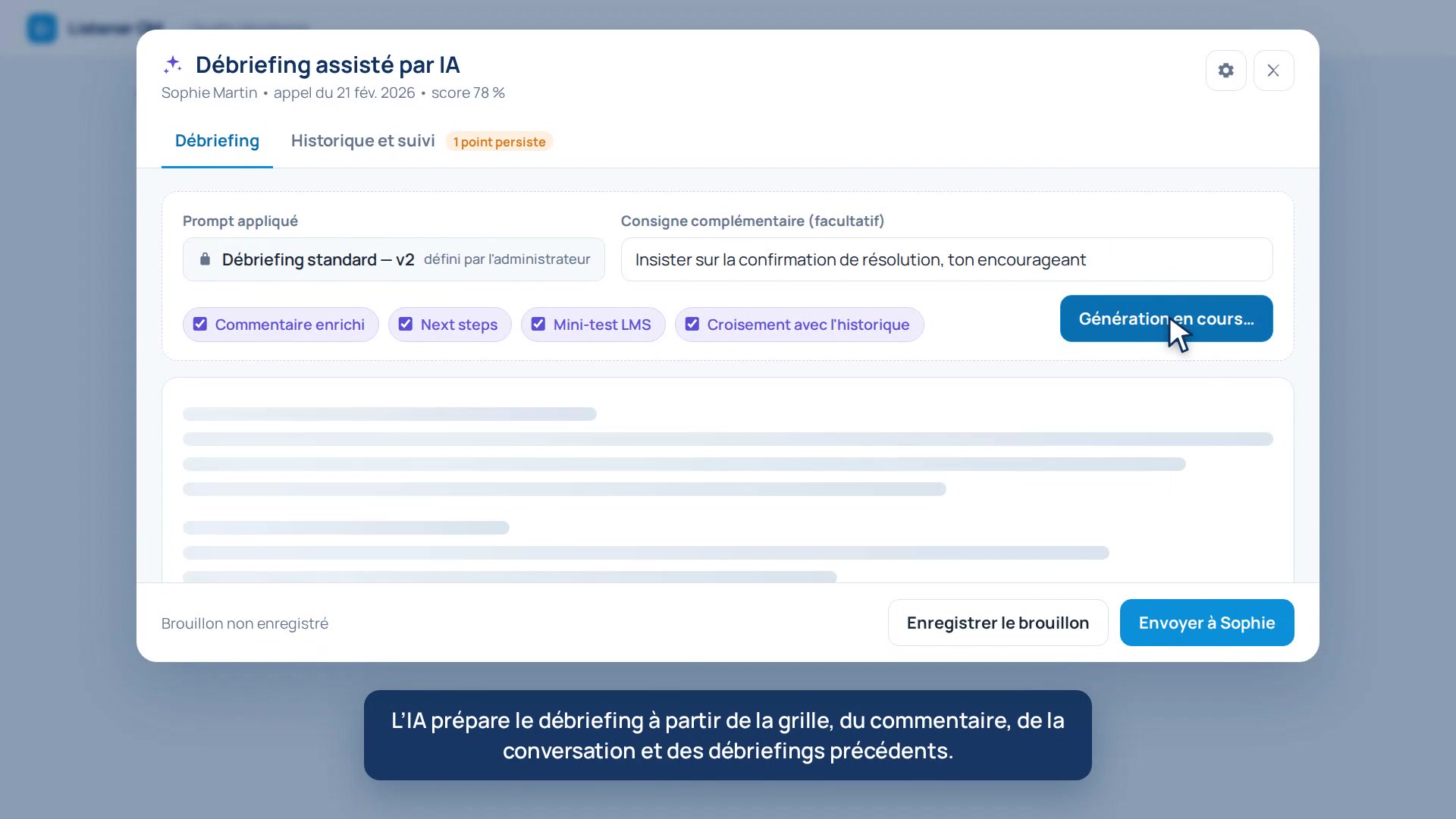
Based on these specifications, we added the AI-assisted debriefing to our Quality Monitoring. The concept can be summed up in one sentence: at the end of the evaluation, a “Debriefing” button opens a window where the AI has already prepared the feedback based on the completed evaluation form, the supervisor’s comments, excerpts from the conversation, and the counselor’s previous debriefings. The supervisor reviews, makes any necessary adjustments, and sends it.
From the supervisor's perspective
- The administrator sets the framework. The debriefing prompt is defined once, versioned, and remains the same for all client evaluations. The supervisor does not write the prompt: they select the blocks to be generated and may add a specific instruction (“emphasize confirmation of resolution, use an encouraging tone”).
- The AI generates four sections: an in-depth, editable commentary; “next steps” linked to each criterion in the rubric, with a note indicating which ones have already been flagged; a mini-test with three questions focused on areas for improvement, intended for the LMS; and a comparison with the advisor’s history.
- The supervisor makes decisions on a block-by-block basis. He or she either approves the mini-test, refines the instructions, and re-runs that block alone without changing the rest, or does not approve it and replaces it with another corrective action: individual coaching, paired listening, an existing module, listening to a sample call, or a role-play.
- He sends it. The debriefing appears in the advisor's dashboard; the test is created in the LMS and linked to the advisor's learning path throughthe integration between Quality Monitoring and the LMS.
For Advisors
The agent does not receive the supervisor’s feedback as-is, but rather a message rephrased for them in a peer-to-peer tone, prepared by their supervisor and signed by them. The agent sees their next steps—which they check off as they complete their calls—their mini-test to take within the app, and their previous debriefings along with their score progression. They can see what each point is based on and can respond to it. Their supervisor can see what has been checked off and the test results.
Back in the day
With each new evaluation, Listener QM cross-references the "next steps" from previous debriefings with the day's evaluation grid and suggests a status for each area of improvement:
An item marked as “done” by the advisor but still rated 3/5 appears as “pending,” not “resolved”: the status is calculated based on ratings, not on self-reports, and the supervisor can adjust it before submission. This is what turns a series of isolated evaluations into a trajectory and a monthly reminder into ongoing support.
Three safeguards to maintain the constraints outlined in the previous chapter: nothing is sent without the supervisor’s approval; each refinement is a targeted call that does not alter the rest; and the re-injected history is limited to the last six months and never contains the complete transcript of previous calls.
What about bots in all this?
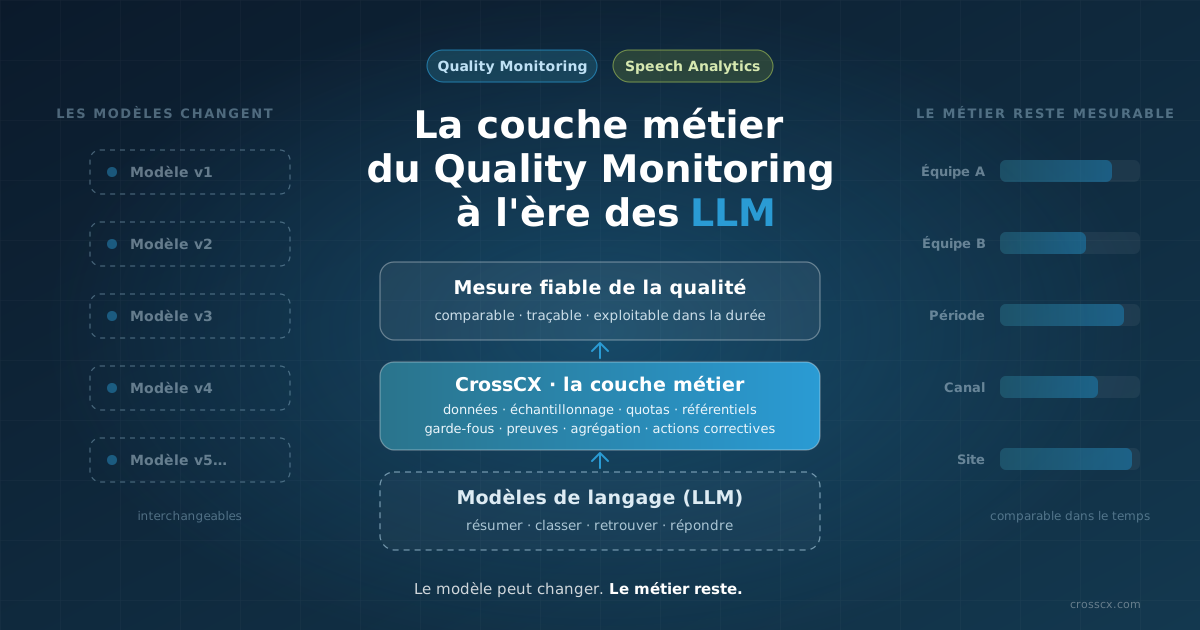
The debriefing is based on the evaluation grid, and the grid is the same for everyone you evaluate: internal advisors, service providers, voice AI agents, or chatbots. For a human, the feedback becomes a debriefing; for a bot, it becomes structured feedback sent back to its developer or knowledge base. The same metric indicates whether the bot is handling the easy tasks and whether the agent is receiving support on the difficult ones. This is the role of a cross-functional “ Quality Monitoring ” layer, and it’s the only way to actively manage the division of roles with full awareness rather than simply reacting to it.
AI handles the easy stuff. The advisor handles the hard stuff.
The debriefing is what helps the advisor cope with it and make progress.
See AI-assisted debriefing on your own evaluation forms
A 30-minute demo tailored to your criteria and use cases.
Frequently Asked Questions
Why conduct more debriefings when the number of people is declining?
Because the conversations that agents end up handling are the most difficult and the ones that have the greatest impact on the brand: complaints, disputes, retaining customers, and situations that aren’t covered by the script. There are fewer evaluations per agent, but each one carries more weight, and the feedback must be commensurate.
Is the debriefing sent automatically to the advisor?
No. The AI prepares a draft during the evaluation; the supervisor reviews it, makes adjustments section by section, and decides whether to send it. Nothing is sent without the supervisor's approval.
Can an advisor challenge a debriefing?
Yes. He sees the rubric, his supervisor's comments, and the relevant points, and he can respond to them. The debriefing is signed by a person, not a model, and it is to that person that he addresses his response.
Who writes the prompt?
The administrator sets this once for all of the client's evaluations. It is versioned and does not depend on the supervisor, who can only add a one-time instruction or fine-tune the generation of a block.
Does it work with automatic " Quality Monitoring " and AI-powered agent evaluations?
Yes. The debriefing is based on the completed form, whether the evaluation was conducted by a supervisor or generated by the automated QM system. For an AI agent, the same process generates structured feedback rather than a message to the agent.
How long is the debriefing history retained?
A maximum of six rolling months, with daily purging. Only a condensed view (axes, statuses, test results) is carried over to subsequent generations; the transcripts of previous calls are never carried over.
Help Your Advisors Tackle the Tough Stuff
The AI-assisted debriefing is available at Listener QM. We'll show it to you on your grids.
- McKinsey, *The Evolution of Customer Care: AI and the Gen Z Effect*, 2024; and *The State of Customer Care in 2022*.
- PwC, 2025 Customer Experience Survey (5,511 consumers and 406 executives, United States).
- Cresta, State of the Agent Report 2024 (1,000 agents, United States); and Will AI replace contact center agents?